Project: Xinfeng North City Resettlement Community Power Distribution Location: Xinfeng County, Jiangxi Province, China
Year: 2024
Client: Xinfeng Urban Construction Investment and Development Co., Ltd.
Total Investment: RMB 730 million (~USD 100 million)
Construction Area: 180,000 m²
End Users: 1,100+ resident households
Scope: Equipment supply: high & low voltage switchgear, dry-type distribution transformers, compact box-type substations
The Challenge: Three Problems That Usually Don't Arrive Together
Most distribution projects come with one dominant challenge. This one brought three simultaneously.
Challenge 1 — Concentrated Peak Demand. With over 1,100 households moving in across residential blocks, commercial retail podiums, and a kindergarten, the load profile was anything but flat. Morning and evening peaks from high-density residential use had to be balanced against daytime commercial and institutional demand. Undersizing capacity would mean brownouts. Oversizing would mean wasted capital and inflated lifecycle costs.
Challenge 2 — Multi-Scenario Reliability Requirements. A resettlement community isn't a factory where you can accept occasional outages. Residents depend on uninterrupted power for heating, cooling, medical devices, and basic safety systems. The standard acceptable for an industrial park simply doesn't apply here.
Challenge 3 — Designing for What Comes Next. Xinfeng County, like many rapidly developing cities across China and emerging markets globally, is building infrastructure that needs to last decades. Photovoltaic integration, EV charging loads, and potential grid-tied energy storage were not requirements on day one — but they needed to be possible on day ten years from now.
What We Actually Delivered
Rather than walking through a standard bill of materials, it's more useful to explain why each equipment category was selected and what role it plays in the overall system.
High & Low Voltage Switchgear Assemblies
At the core of this project's distribution architecture are high and low voltage switchgear assemblies — the components responsible for receiving power from the utility grid, protecting circuits from faults, and distributing electricity to each load group within the community.
For a residential community of this scale, switchgear selection is a balance between protection depth and space efficiency. Our
KYN28A-12/24 metal-enclosed drawout switchgear was deployed at key substations for incoming and outgoing feeder control. Its IP4X enclosure rating and arc fault pressure relief channel made it the right fit for indoor distribution rooms shared with occupied buildings.
Low-voltage distribution relied on our GCK/GCS/MNS series draw-out LV switchgear, offering flexible functional combinations and IP30/IP40 protection ratings configurable by application — useful when the same switchgear family has to serve both residential and light commercial loads within the same distribution room.
The "five-prevention" mechanical interlocking — a key safety requirement for densely populated environments — was implemented across all switchgear assemblies, preventing misoperation under all switching conditions.
China's "five-prevention" standard is closely aligned to IEC 62271-200 internal arc accessibility criteria. For example, with an EPC contractor specifying similar projects within Eastern Europe, cross-referencing of structural equivalences based on IEC standards will be simple. The same is true for Middle Eastern Utilities' specifying projects subject to DEWA or SEC technical specifications, and Southeast Asia's grid operators with mixed IEC/ANSI applications; therefore, project-specific documentation packages are maintained to facilitate compliance. Please contact our engineering team for a summary of your project’s compliance mapping.
Compact Substations:
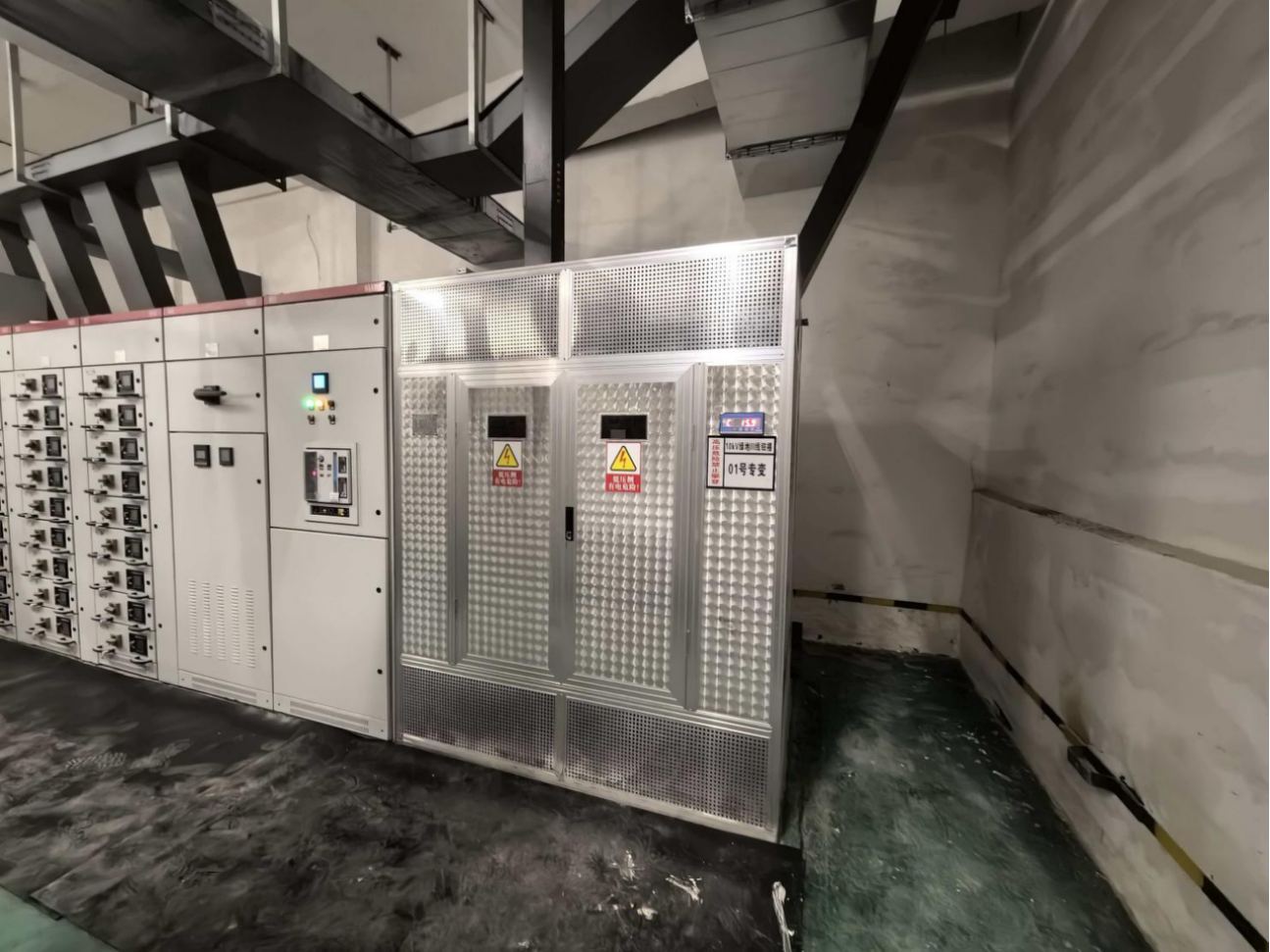
Typical substation construction rooms would have consumed a considerable proportion of buildable floor space — approximately 180,000 m² of mixed-use buildings. By using compact box-type substations — combining high-voltage (HV) switchgear, distribution transformers and low-voltage (LV) distribution boards into a single weatherproof enclosure — EPC Contractors were able to create substations that were massively smaller than conventional designs.
EUE Power's
Chinese box-type substations currently installed in a specific location take up only 58% of the floor space of an equivalent European box-type substation, but still provide fully sealed, rainproof, dustproof, corrosion-resistant outdoor-rated structures. In addition, the substations are designed with a microcomputer-based automated integrated system for remote measurements, remote indications, remote control, and remote adjustments.
Compact substations were not merely an added convenience for an EPC contractor looking to locate substations in conjunction with a landscape design, traffic flow plan, or access to emergency services; they were seriously considered to be part of the overall design.
Distribution Transformers
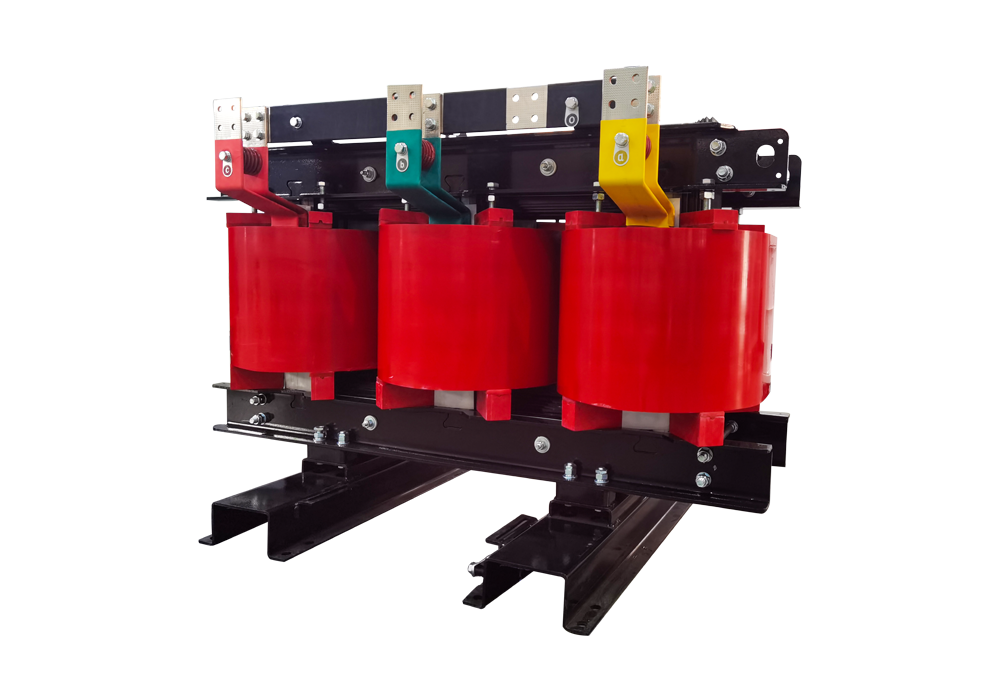
All substations utilize a transformer at every node to decrease voltage levels from 10kV distribution to a usable voltage level for residential and commercial loads of 0.4kV. Dry-type distribution transformers are the specified type for indoor adjacent installations as well as for residential installations with high density of loads.
Our
SC(B)11 Three Phase Epoxy Cast Dry-Type Power Transformers demonstrate noise levels lower than 55 dB (essential for residential applications), are fully compliant with energy efficiency standards, provide core options of amorphous alloy material that decrease no-load losses, and use Class F/H Insulation systems that can continually operate without the need for oil maintenance. By not requiring flammable insulating oil, we eliminate a major source of fire hazard in residential areas.
The use of slotted core tie plates eliminates eddy current losses in the structural components. Optimisation of leakage flux calculation reduces stray losses. These features yield a transformer family that operates at lower temperatures, is quieter, and is more efficient than traditional transformer designs — factors that will make a difference to facility managers and ESCOs who manage long-term O&M contracts.
The Reserved Interfaces: Designing for a Grid That Doesn't Exist Yet
One of the decisions we're most satisfied with on this project was insisting on reserved interfaces for future clean energy integration — even though no PV or storage system was in the scope.
Here's the practical reasoning: The cost of adding reserved connection points for photovoltaic grid tie-in, EV charging feeder provisions, and potential
battery energy storage system (BESS) hookups during initial construction is a small fraction of what retrofit engineering costs later. In markets where building-integrated PV and community-scale energy storage are moving from optional to mandatory — particularly in the EU under the revised Energy Performance of Buildings Directive, and in the GCC under national net-zero targets — this kind of "one-time design, long-term adaptability" philosophy is shifting from good practice to contractual expectation.
For EPC contractors working in Saudi Arabia, UAE, or EU jurisdictions where building energy codes are tightening rapidly, this is worth building into your standard specifications now. Our engineering team can model future PV and storage integration loads as part of the initial distribution system design at no additional cost — because it's far cheaper to plan for it than to retrofit for it.
EPC Contractors Should Consider These Lessons When Planning Energy Supply Systems For Residential Homes
Whether you're specifying power distribution equipment for a housing development in Poland, a social housing scheme in the UAE, a township electrification project in Indonesia, or a mixed-use urban development in Romania, these principles transfer directly from what we saw on this project.
-
Treat the load profile as a variable, not a fixed input. Residential load diversity factors behave very differently from industrial or commercial profiles. Peak demand calculations that assume simultaneous full-load draw across all units will significantly oversize your transformer capacity. Work with the developer to model actual occupancy phasing — the equipment sizing follows from there.
-
Lock in compact substation locations early. Late-stage repositioning of substation enclosures cascades into underground cable routing changes, civil works variations, and commissioning delays. The earlier substation positions are fixed in site planning, the cleaner the rest of the design process runs.
-
Reserve capacity for PV and storage — even when it's not in the tender. An increasing number of tenders include long-term grid code compliance requirements. Specifying reserved interface provisions during initial equipment procurement avoids costly variation orders when those requirements arrive.
-
Make maintainability a formal selection criterion. Equipment that requires specialist tooling, proprietary diagnostic software, or manufacturer presence for routine maintenance creates long-term operational risk — particularly for projects in locations where OEM technical support is geographically remote. Maintainability should sit alongside price and performance in your evaluation matrix.
-
Request IEC compliance documentation upfront. For projects governed by IEC standards — which covers most of Europe, the Middle East, and Southeast Asia — Chinese manufacturers who can provide comprehensive IEC test documentation reduce your technical risk significantly during client acceptance testing and grid connection approval. Ask for it early; a reputable supplier will have it ready.
Ready to Talk About Your Project?
If you're an EPC contractor, project developer, or utility working on power distribution infrastructure in Europe, the Middle East, Southeast Asia, or Eastern Europe, we'd welcome the conversation.


 English
 Русский